
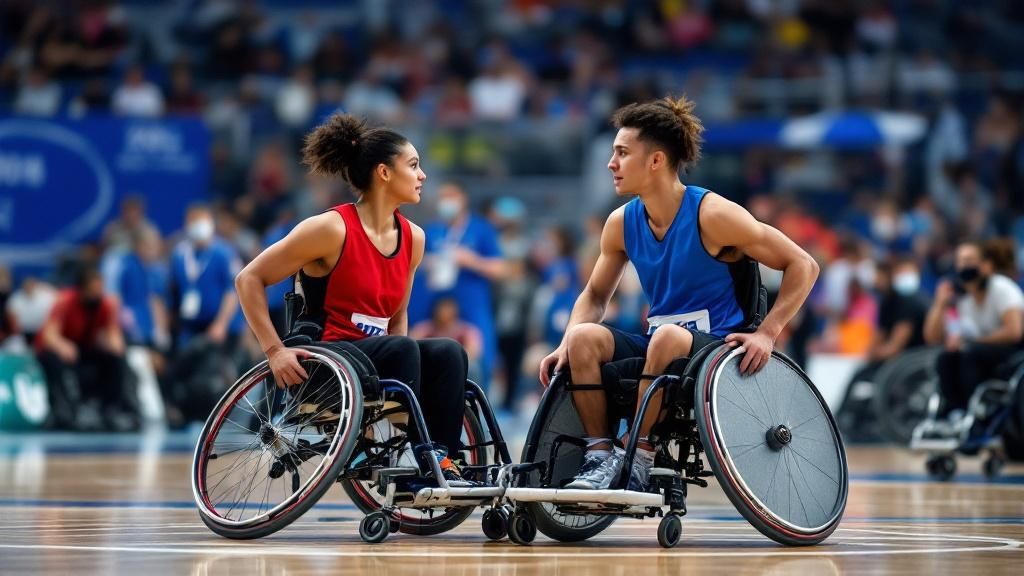
Wheelchair basketball athletes have enthralled audiences worldwide by showcasing exceptional athletic prowess and technical excellence at the renowned International Championship. These exceptional players have demonstrated that disability presents no barrier to elite sporting excellence, delivering breathtaking performances that rival any major league competition. From swift dribbling skills to impressive dunks, participants have broken down misconceptions whilst competing at the highest level. This article investigates the defining performances, record-breaking achievements, and inspiring narratives that shaped this significant occasion in adaptive sports.
Remarkable Performances Highlight Top-Tier Talent
The International Championship witnessed an extraordinary display of athletic prowess as wheelchair basketball competitors exhibited the finest standard of ability and resolve. Athletes performed intricate defensive tactics with impressive accuracy, whilst their attacking moves displayed impeccable court awareness and technical mastery. The intensity of competition proved that these top-tier athletes operate at a standard equivalent to mainstream professional basketball, engaging spectators with their dynamic athleticism, strategic brilliance, and unwavering commitment to success across the competition.
Several standout performances engaged both audiences and commentators, with individual athletes delivering striking demonstrations of precise shooting and handling skills. One standout match showcased a player performing a run of three-point shots with impressive consistency, displaying the polished technical capabilities built over years of focused preparation and competitive play. These displays of individual skill enhanced the general entertainment value, highlighting the diverse skill sets that wheelchair basketball athletes demonstrate and their capacity to compete under demanding conditions at championship level.
The tournament also displayed exceptional teamwork, with coordinated plays and fluid ball movement exemplifying the advanced strategic methods employed by competing nations. Coaches exhibited remarkable strategic innovation, utilising intricate tactical setups and transitional plays that held viewer attention. The synchronisation between teammates, combined with rapid wheelchair mobility, delivered a compelling athletic display that went beyond traditional basketball conventions and reset benchmarks concerning inclusive competitive sport.
Record-breaking achievements emerged throughout the championship, with multiple competitors exceeding previous statistical benchmarks in scoring, assists, and defensive contributions. These accomplishments underscore the continuous evolution of wheelchair basketball as competitors extend the limits of athleticism and skill, setting fresh benchmarks for excellence. The pursuit of these records inspired athletes to deliver consistently outstanding performances, enhancing the standard of competition and inspiring upcoming players of wheelchair basketball competitors worldwide.
The championship’s triumph ultimately showcased the devotion, strength, and outstanding skill of wheelchair basketball athletes who remain committed to advancing inclusive sports on the international stage. Their performances went beyond sporting achievement, communicating significant statements about human potential and what’s possible. By showcasing world-class abilities and unwavering determination, these exceptional individuals have cemented wheelchair basketball’s position as a top disability sport deserving global recognition and recognition.
Technical Excellence and Tactical Play
The International Championship featured wheelchair basketball athletes executing sophisticated offensive strategies with exceptional accuracy. Players demonstrated outstanding dribbling skills, implementing intricate pick-and-roll formations and rapid-fire passing sequences that dissected opposing defensive structures. Their positional awareness and positioning was exceptional, with competitors employing sophisticated strategic plays to generate scoring opportunities. The level of technical proficiency shown matched top-level conventional basketball, highlighting the sport’s competitive sophistication and demanding skill requirements.
Defensive Excellence and Control of the Court
Defensive displays across the tournament exemplified high-calibre intensity and strategic skill. Athletes deployed aggressive pressing tactics whilst preserving disciplined positional awareness. Their skill in reading opponent actions, combined with swift wheelchair mobility, created imposing defensive structures. Teams displayed advanced zone defences and man-to-man coverage systems, successfully neutralising opposing offences and forcing critical turnovers throughout intense periods.
Court control emerged as a key feature of championship-winning teams. Athletes retained the ball through strategic passing patterns and smart ball circulation patterns. Their grasp of spacing, timing, and floor positioning showcased basketball intelligence comparable to professional competitions. Wheelchair mobility combined with tactical awareness allowed teams to control game tempo, shape the game, and establish psychological dominance throughout matches.
- Aggressive full-court pressing generated instant defensive intensity regularly.
- Swift wheelchair movement facilitated effective transition defence execution.
- Complex zone defences countered adversary offensive tactics efficiently.
- Anticipatory positioning forced critical turnovers at vital moments.
- Structured team defence preserved tactical shape throughout competitions.
Impact on the Sport and What Lies Ahead
The International Championship has substantially increased wheelchair basketball’s profile on the worldwide sports landscape. Broadcast exposure has increased markedly, attracting sponsorship from major corporations and growing television audiences across multiple continents. This increased prominence has inspired younger athletes to take up wheelchair basketball professionally, strengthening development programmes and community programmes worldwide. Sports authorities now recognise the business and cultural significance of disability sports, pledging substantial investments in facilities, coaching infrastructure, and athlete support systems for ongoing expansion.
Looking ahead, the sport confronts exceptional prospects for expansion and innovation. Technical improvements in wheelchair design keep improving performance capabilities, whilst rule modifications aim to improve competitive equity and spectator appeal. International federations are establishing clearer pathways for athletes moving from community level to professional sport. Furthermore, enhanced Paralympic prominence promises broader societal embrace and funding prospects. These developments suggest wheelchair basketball will continue flourishing, ultimately changing views of disability in sport and inspiring millions globally.
